

Inside Our Coorg Farm Visit
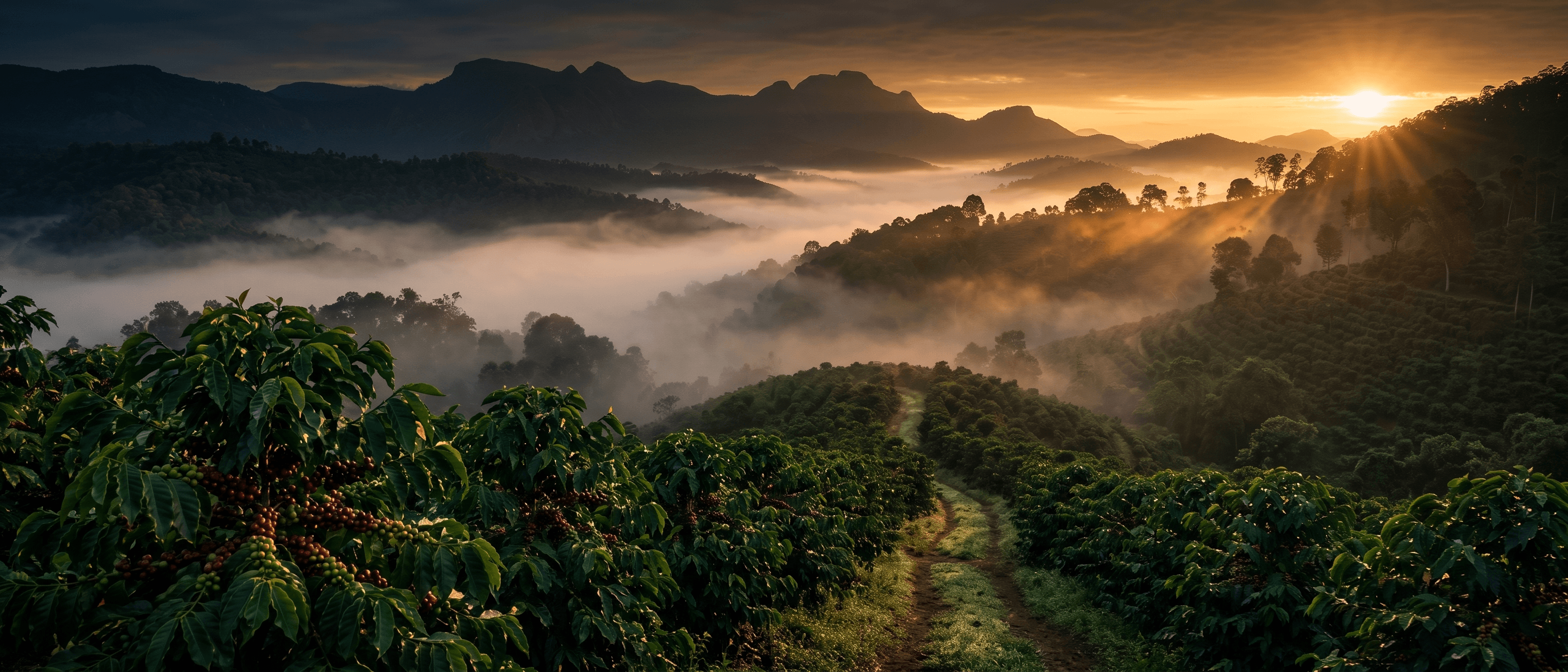
Three days with farming families in Kodagu at 1,100 metres. Misty mornings, red cherries hand-picked at dawn, and three generations of farming knowledge passed down without a manual. We walked the rows, sat in the drying yards, and watched a process that has barely changed in fifty years. Shade-grown trees slow everything down — the cherry takes longer to ripen, the bean grows denser, the flavour compounds multiply. The washed process strips the fruit within hours of picking. Raised beds in the open sun for twelve days. Then silence, until it reaches our roastery. All of it ends up in the cup you make each morning.
Coorg sits in the Western Ghats at about 1,100 metres above sea level. The British colonists called it the Scotland of India — rolling green hills, perpetual mist, dramatic rain. What they were actually describing, without knowing it, were the exact conditions that make it one of the finest coffee-growing regions on earth.
We spent three days in Kodagu district last March, staying with two farming families who have been growing coffee on these hills for generations. This is what we found.
The Altitude Advantage
At 1,100 metres, nights in Coorg are cool — sometimes cold — even in summer. This temperature differential between day and night is the secret behind the flavour. Coffee cherries take longer to ripen at altitude. A slower maturation means the cherry has more time to transfer its sugars and organic acids into the bean. The result is a more complex flavour profile than you would ever get from low-altitude, fast-grown coffee.
Coorg Arabica has a characteristic brightness — a mild citrus note — and a clean, round body. It is not the most dramatic coffee in the world, but it is remarkably consistent and deeply honest.
The Families Behind the Beans
The first family we visited has 40 acres planted in Arabica. The patriarch, now in his sixties, learned coffee farming from his father who planted the estate in 1968. His son manages the agronomics now — they moved away from chemical pesticides eight years ago, back to the traditional shade-grown method using native forest trees as canopy.
Shade-grown coffee is slower. The canopy competition means trees put more energy into fewer cherries — but those cherries are denser, heavier, and more flavourful. It is also better for the ecosystem — the same trees that shade the coffee host birds that naturally control insects. The farm is alive in a way that a monoculture never is.
The patriarch's farm has been growing Arabica since 1968. Three generations. The same trees. The same hills. That continuity is in every jar.
How the Coffee Is Processed
Coorg uses predominantly the washed (wet) process. After selective hand-picking, the outer fruit is removed within 24 hours using small wet mills on the estate, and the beans are fermented in water tanks for 24–48 hours to remove the remaining mucilage. Then they dry on raised beds in the sun for 10–15 days.
The washed process gives the coffee its characteristic clarity — each cup reflects the bean's intrinsic qualities without the fruit-forward heaviness of natural-processed coffee. It is why Coorg Arabica has that clean, bright quality that makes it so well-suited to instant production.
From the Farm to Your Jar
After drying, the green beans are transported to our roastery in Surat. We roast in small batches — never more than 20 kilograms at a time — on a drum roaster, using a slow-roast profile that takes about 18 minutes per batch. The slow roast develops the Maillard sugars without burning the delicate oils that carry the origin character.
Then spray-drying at low temperature. The fresh roasted coffee is brewed into a concentrate and spray-dried at a temperature low enough to preserve the volatile aromatic compounds. The result is a granule that holds the flavour of the fresh roast — not a degraded approximation of it.
We went back to Coorg to understand where this starts. The jar is the end of a very long, carefully managed chain. Every step matters — and the farmers at the beginning of that chain are the people it matters most to get right.
The origin in your cup
Classic and Hazelnut use Coorg Arabica as their primary origin. Every jar carries the altitude, the mist, and the 50-year-old farming knowledge of Kodagu.