

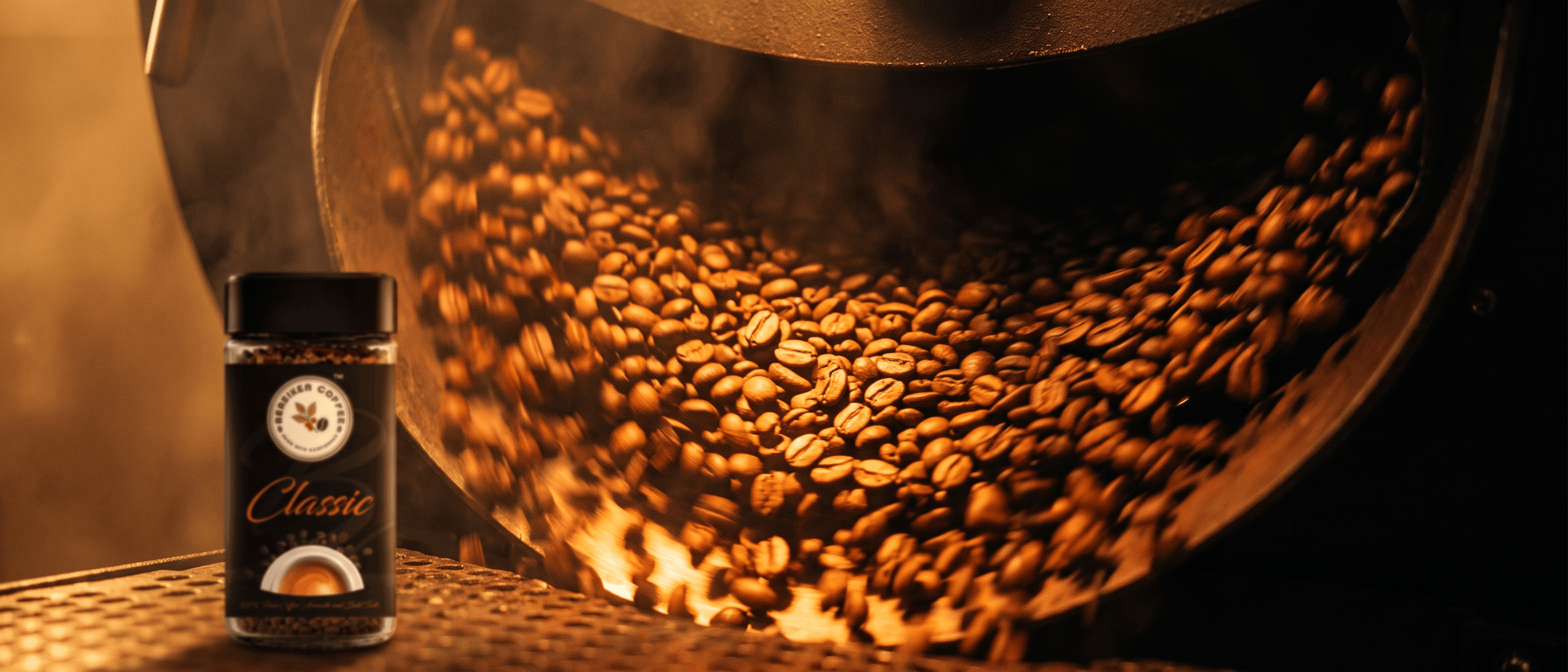
The Story Behind Bereiken Classic
Eight months of sourcing. Fourteen test batches. One roast profile that has not changed since the first production run. How India's first premium instant Arabica came to exist.
Before there was a Bereiken jar, there was a problem. Every instant coffee available in India tasted the same — harsh, bitter, flat. The category had been colonised by commodity Robusta for so long that most people assumed this was simply what instant coffee was. It was not a quality problem, they thought. It was a category problem.
It was not. It was a sourcing problem. And our founder, whose family has been in the tea business through Vagadia Tea Company for three generations, knew the difference between a category defined by its worst players and a category defined by what was actually possible.
The Search for the Right Bean
The first decision was non-negotiable: 100% Arabica. Not a blend, not a Robusta base with Arabica marketing. Every gram of Bereiken Classic uses Arabica beans from Coorg and Araku Valley — the two Indian growing regions with the altitude and microclimate capable of producing beans with genuine flavour complexity.
We spent eight months sourcing before we roasted a single test batch. We visited estates in Kodagu. We cupped hundreds of lots. We were looking for a specific profile: clean brightness without excessive acidity, a round medium body, no harsh finish. Something that would taste unmistakably like good coffee black, but also hold its character through milk.
Getting the Roast Right
Roasting for instant production is different from roasting for espresso. In espresso, a slightly darker roast compensates for the 25-second extraction — you need the caramelised sugars to carry the shot. In instant, the extraction is longer and more complete. A dark roast becomes bitter. A light roast is too grassy and sharp.
Classic is a medium roast — 18 minutes on a drum roaster at a temperature profile that peaks at around 205°C. It takes 14 test batches to land on the exact profile. Too fast and you get baked, flat notes. Too slow and you lose the brightness. The curve matters enormously.
Fourteen test batches. Eight months of sourcing. One roast profile that has not changed since the first production run.
Spray-Drying Without Destroying
Most industrial spray-drying uses high temperatures — it is faster and cheaper. High-temperature drying destroys the volatile aromatic compounds that give roasted coffee its character. What survives is the bitterness and the body — the texture — but the complexity is gone.
We use a low-temperature spray-drying process. It takes longer. It requires more precise control. The granules that come out are irregular — not the perfectly uniform spheres of mass-market instant — because the process is gentler. The payoff is that what you smell when you open a jar of Classic is actual roasted coffee aroma, not the stripped-back industrial version.
The First Sale
The first production batch of Classic sold out in eleven days. Most of it went to people who knew the family — friends, relatives of colleagues, existing Vagadia Tea customers who were curious. The feedback was consistent: it did not taste like instant coffee. That was the point.
Classic remains our bestseller. The recipe has not changed. The sourcing estates have not changed. The roast profile has not changed. When something works — genuinely works — you leave it alone.
What Classic Is For
Classic is the cup you make when you want coffee — not a flavoured coffee experience, not a recipe, not a social media moment. Just 2 teaspoons, 200ml at 90°C, and three minutes of your morning. It is designed to be the best possible version of the simplest possible thing.
The original
Classic is where Bereiken started. It is still the one that converts people who say they do not like instant coffee.